
The United States Central Command (CENTCOM) announced that it has launched a fresh round of military strikes against Iranian targets after accusing Iran’s Islamic Revolutionary Guard Corps (IRGC) of attacking a Cyprus-flagged container ship in the Strait of Hormuz.
Table of Contents
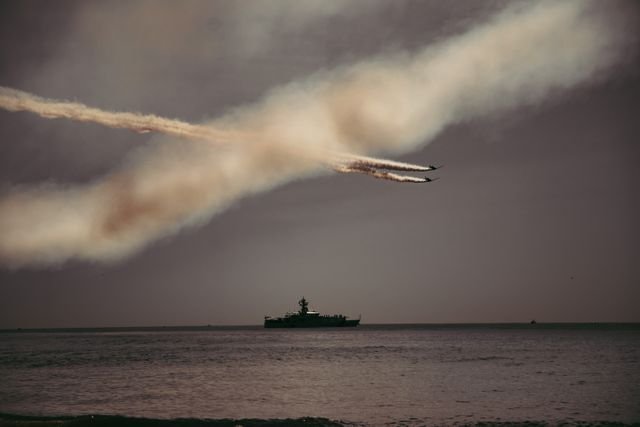
CENTCOM says Trump ordered strikes to degrade Iran’s capabilities
The United States Central Command (CENTCOM) said President Donald Trump ordered a series of military strikes aimed at degrading Iran’s military capabilities following the recent escalation in the Strait of Hormuz.
Iran’s Islamic Revolutionary Guard Corps (IRGC) Navy announced that the Strait of Hormuz has been closed “until further notice,” a move that could significantly disrupt global oil shipments and international maritime trade.
Tehran warned that any act of aggression against Iran would be met with a “severe response,” escalating fears of a broader regional conflict. The latest developments have heightened concerns among global markets and governments over the security of one of the world’s most critical shipping lanes.
Officials are closely monitoring the situation as tensions between the United States and Iran continue to rise.
US launches fresh strikes on Iran after alleged attack on container ship in Strait of Hormuz
The US military said on Saturday it had launched a fresh round of strikes against Iran after accusing Tehran of carrying out an attack on a commercial container ship transiting the Strait of Hormuz.
According to the US Central Command (CENTCOM), the operation began at 7:15 p.m. Washington time (2315 GMT) and was ordered in response to what it described as a blatant attack by Iran’s Islamic Revolutionary Guard Corps (IRGC) on a Cyprus-flagged container vessel.
CENTCOM said the strikes were intended to respond to the incident and degrade Iran’s military capabilities following the alleged assault on international shipping in one of the world’s most strategically important waterways.
The Strait of Hormuz remains a critical global energy corridor, and the latest escalation has heightened concerns over regional stability, maritime security, and the potential impact on global oil supplies. Iranian authorities have not yet publicly responded to the US military’s latest claims.
“The United States is imposing a heavy cost by continuing to degrade Iran’s ability to attack civilian mariners and commercial vessels freely transiting the Strait of Hormuz,” the US Central Command (CENTCOM) said in a statement.
CENTCOM added that the latest military strikes were carried out at the direction of President Donald Trump as part of efforts to protect international shipping and deter further attacks on commercial vessels operating in the strategic waterway.
US Defense Secretary Pete Hegseth defended the latest military action, saying, “Iran made a poor choice. Now they pay.”
Meanwhile, Iran’s Islamic Revolutionary Guard Corps (IRGC) announced that the Strait of Hormuz would be closed “until further notice,” according to state media.
The IRGC said its naval forces had fired warning shots at a vessel accused of using an unauthorized route through the strategic waterway. The developments mark a further escalation in tensions, raising concerns over the security of one of the world’s busiest maritime shipping lanes.
The latest escalation threatens to further complicate efforts to revive US-Iran negotiations after both sides exchanged military strikes in recent days.
Earlier incidents involving Iranian strikes on vessels transiting the Strait of Hormuz prompted retaliatory exchanges between Iran and the United States, intensifying tensions and fueling sharp rhetoric from both sides.
A major obstacle to any future agreement remains the status of the Strait of Hormuz. Tehran maintains that it has the authority to regulate shipping through the strategic waterway, while Washington insists on the principle of unrestricted freedom of navigation.
The renewed hostilities came as Iran’s Supreme Leader vowed retaliation over the US-Israeli killing of his father and predecessor, while President Donald Trump warned of severe consequences should any attempt be made on his life.
The growing tensions have also cast doubt over efforts to preserve an interim agreement aimed at ending the regional conflict that erupted in late February following large-scale US-Israeli strikes that killed former Supreme Leader Ali Khamenei.
‘Dual-route Hormuz shipping plan’
Iranian Foreign Minister Abbas Araqchi and Omani Foreign Minister Badr Albusaidi met in Oman to discuss mechanisms for ensuring the safe passage of commercial vessels through the Strait of Hormuz.
According to a statement from Iran’s Foreign Ministry, the two sides exchanged views on “appropriate mechanisms for the safe passage of ships through the Strait of Hormuz.”
Oman’s state news agency reported that Iranian and Omani negotiators would continue discussions at both the technical and political levels as diplomatic efforts to ease regional tensions continue.
CNN reported on Saturday that Oman has presented a draft proposal aimed at easing tensions in the Strait of Hormuz by introducing a dual-route navigation system.
According to the report, commercial vessels would be allowed to navigate freely through the southern shipping corridor located in Omani territorial waters. Ships using the northern corridor, which passes through Iranian territorial waters, would be required to obtain prior approval from Tehran, although no transit fees or tolls would be imposed.
The White House and the US State Department did not immediately comment on the reported proposal.
Senior US officials have said Washington wants Iran to publicly commit to ending attacks on commercial shipping in the Strait of Hormuz and to guarantee that all navigation lanes remain open without restrictions or tolls.
Iranian Foreign Minister Abbas Araqchi, however, accused the United States of violating the ceasefire agreement, writing on X on Friday: “There can only be mutual compliance.”
The United States revoked the licence authorising the sale of Iranian crude oil on Tuesday after three commercial tankers from Qatar and Saudi Arabia came under fire earlier in the week. The incidents prompted US strikes on Iranian targets, followed by retaliatory Iranian attacks on US military facilities in Gulf states, further escalating the regional conflict.
